Selected Work for Zayo

Rebuilding GTM for the B2B Buyer
Rebuilding GTM for the B2B Buyer
Rebuilding GTM for the B2B Buyer

AI-Enabled, Audience-Led Growth
Rebuilding GTM for the B2B Buyer
Rebuilding GTM for the B2B Buyer
Rebuilding GTM for the B2B Buyer

The Opportunity
The tech company had strong products and deep credibility within its market, but its go-to-market motion was not designed to reach the right audiences with the right message at the right time.
A broad, consumer-oriented demand model emphasized lead volume over audience fit, buying intent, and revenue potential. This contributed to low conversion, uneven pipeline quality, and growing friction between Marketing and Sales.
At the same time, Marketing, Sales, and Customer Success were operating with disconnected processes and different measures of success.
The opportunity was not simply to improve campaign performance. It was to create an integrated revenue system built around the right audiences, clearer buyer value, and shared commercial outcomes.

The Audience Insight
The issue was not a lack of market opportunity. It was a lack of focus.
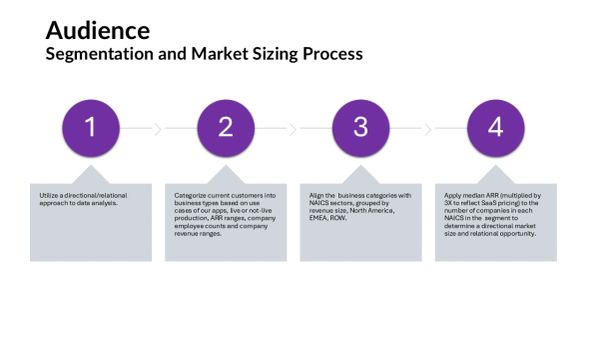
I analyzed the existing customer base, revenue concentration, product adoption, industry segments, company size, and use cases to understand where the company was winning and where it had the clearest opportunity to grow.
The Strategic Move
I shifted the marketing strategy from broad, volume-driven demand generation to a focused B2B go-to-market strategy built around priority segments, buying intent, and revenue potential.
Rather than treating Marketing, Sales, and Customer Success as separate functions, I redesigned the go-to-market motion as one integrated revenue system. The teams aligned around shared audiences, coordinated market activation, and common objectives tied to pipeline, conversion, retention, and growth metrics.
The strategy shifted investments to the segments where the company had the strongest product fit and right to win, while introducing more targeted acquisition, account-based marketing, and land-and-expand programs across the customer lifecycle.
What I Built
I translated the strategy into a repeatable go-to-market operating system that connected market focus, audience relevance, coordinated activation, and revenue accountability.
Find the right market
Rebuilt the TAM and SAM, identified whitespace opportunities, and prioritized the segments and target accounts with the strongest product fit, buying potential, and right to win.
Create the right portfolio story
Refined value propositions, positioning, content, and campaign messaging around distinct audience needs, use cases, buying environments, and the differentiated value of the product portfolio.
Activate as one revenue team
Established a stronger Marketing and Sales interlock through shared audiences, coordinated campaigns, regular revenue standups, closed-loop feedback, and common accountability for pipeline quality, conversion, retention, and growth.
The Impact
Introduced targeted acquisition, account-based marketing, sales enablement, and land-and-expand programs designed to increase adoption, cross-sell, upsell, retention, and customer lifetime value.
Within six months, the new go-to-market motion produced measurable gains across revenue, conversion, retention, and engagement.
- Doubled new business growth via a new segment strategy and GTM motion.
- Increased MQL-to-SQL conversion from 24% to 59%. Improved pipeline quality and increased the percentage of marketing leads qualified by sales.
- 95% net retention rate. Supported customer growth and retention through stronger lifecycle alignment.
- 2–3× increase in engagement rates. Increased response to more targeted, audience-relevant campaigns.
AI-Enabled, Audience-Led Growth

The Opportunity
A B2B tech company had strong operational capabilities, deep industry expertise, and an established reputation, but its marketing foundation had not kept pace with the company’s growth ambitions.
The portfolio was complex, spanning data center infrastructure, end-user devices, mobility, logistics, data destruction, and resale and recycling. The market story needed to become clearer, more audience-focused, and easier for Sales and customers to understand.
At the same time, marketing resources were limited. Building a traditional team and production model would have slowed progress and increased cost.
The opportunity was to create a lean, AI-enabled marketing operating system that could accelerate research, positioning, content development, design, campaign planning, and execution without sacrificing strategic judgment or quality.
The Audience Insight
Through customer research, I learned that enterprise buyers shared four common objectives: reduce risk, simplify complex operations, recover more value from technology assets, and demonstrate that every asset had been managed responsibly.
While these outcomes united the buying committee, each stakeholder viewed success through a different lens.
- IT and Security leaders prioritized governance, chain of custody, data protection, and defensible audit proof.
- Operations teams needed predictable execution, end-to-end visibility, and fewer manual processes.
- Finance leaders focused on cost control, value recovery, and extending the useful life of existing technology.
- Sustainability leaders required measurable reuse, responsible recycling, and credible environmental reporting.
- Data Center, End-User Computing, and Mobility teams each managed distinct asset types, operational workflows, and risk profiles that required tailored solutions.
The Work Product

Website Refresh: Led a complete website transformation grounded in audience insights. Refreshed the messaging, modernized the visual experience, reorganized the portfolio around customer outcomes. Optimized content for both humans and AI discovery via Answer Engine Optimization (AEO) and Generative Engine Optimization (GEO). LLM-optimized content included definitions, process and FAQs.

Built this webpage using Figma Make’s AI agent to rapidly translate strategy, messaging, and design into a prototype that could be published as a webpage or adapted into brochure content.